We’re all still trying to make sense of the new PSL season, even if a few narratives are starting to take hold as trends. Take a quick look at the table and a few things stand out, mostly how Sundowns, Chiefs and Orlando Pirates remain undefeated. They are also the only teams into double figures for goals. On the other end, four teams have no win through Matchday 6. It is here that narratives start to get interesting.
This is the first time in PSL history that so many teams are winless at this stage.
The bottom 10 teams have 6 wins between them (as many as Sundowns have on their own)
There have only been six 1-0 wins (1-0 was the most common last season, occurring in 25% of games). This season only 12% of games have finished 1-0, and if that holds, it will be an all-time PSL low. The current floor is 18%, set in 2011/12, which was the last season the league cleared 580 goals.
100 goals were scored by the 42nd game (11 faster than last season), and the quickest we’ve gotten there since 2015/16.
The trend seems to be that Top 4 from last season are breaking away early again. Already, they are in place as the Top 4 this season, and unsurprisingly, are the top four for the 2026 calendar year too. There is a lopsidedness to it, with Sundowns and Pirates also forming their own faction within the faction. And it’s not just about the table
Amazulu’s 13 points from 6 is their best return at this stage in PSL history
Sundowns 2.4 goals per game is their best goal start at this stage in PSL history.
Pirates’ 2.4 goals per game is their joint-best scoring start at this stage in PSL history, matched only by Kosta Papic’s free flowing side from 2004.
Even Chiefs’ 12 goals from 6 games is their best start since 2012/13.
Moreover, Sundowns and Pirates each won 8 of their first 10 games across competitions. An 80% start from 10 games is so rare in the PSL - it’s something that has happened fewer than 8 times in 30 years. This is the first season two teams start so strongly in the same campaign.
This visual shows the last 10 seasons points per game distribution at this stage of the league season (50 games in). Pirates and Sundowns are not at perfect records, but they are clearly above the rest. It seems there are about three ‘classes’ spread out - the top 4, the middle 8, the bottom 4. Last season, you can see the same shape - a top 3, middle 6 and bottom 7. Except, this season’s middle class are not as wealthy (points wise) as last season’s equivalent.
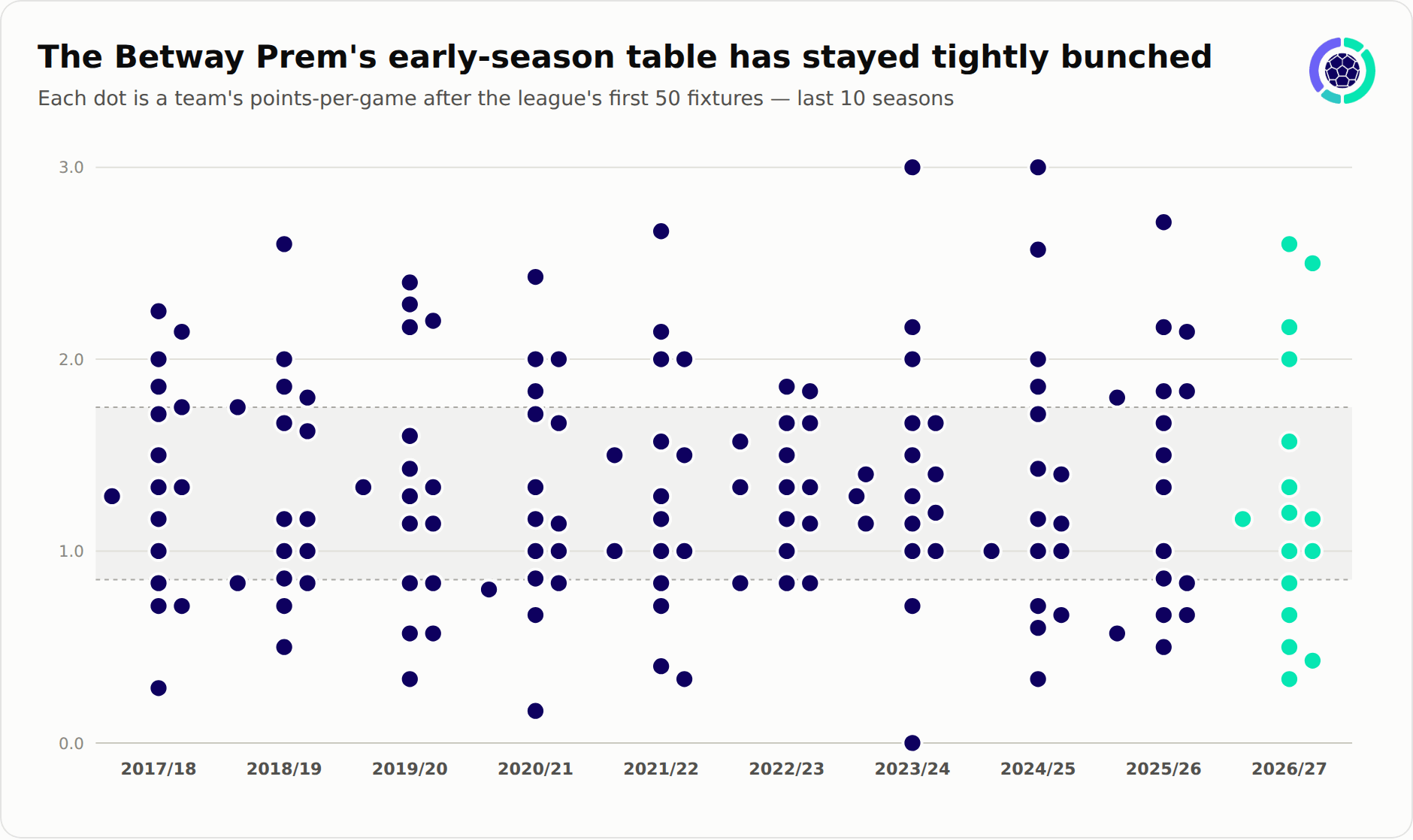
You can go back 10 seasons and make your own reading. The shape of the table isn’t just a calendar trick. This really looks like a top-heavy edition of the PSL, reminiscent of the late 90s and early 00s when 2.2 points per game was the going rate for Chiefs and Sundowns at the top. But again, the main question so early is simple - will this last? A red hot start is sustainable if the underlying numbers match it. To peek into the future, we look past the actual points and consider what powers them - consistency in creating high quality chances and suppressing them at the other end. That brings us to Expected Points. How long a car keeps going depends on the engine and fuel, not just on the current speed.
Instead of a table, we’ve rejigged this to a dumbbell chart, showing the gap between points earned (purple) and points expected (blue). From this, Sundowns (+1.8) & Pirates (+2.6) are slightly performing above expectation, while Chiefs are on par, perhaps reflecting exactly what they may be for the rest of the season - a team with enough talent to score goals, but not enough structural cohesion to keep goals out (yet). AmaZulu are the interesting case - 13 points against 9.2 expected is exactly what they did last season, finishing 4th on numbers that read like 13th. A few months of anomaly can be attributed to variance, but 18 months might be onto something our model can’t see. Still, the safe money is on regression, unless their red hot striker can continue scoring with every third shot he takes.
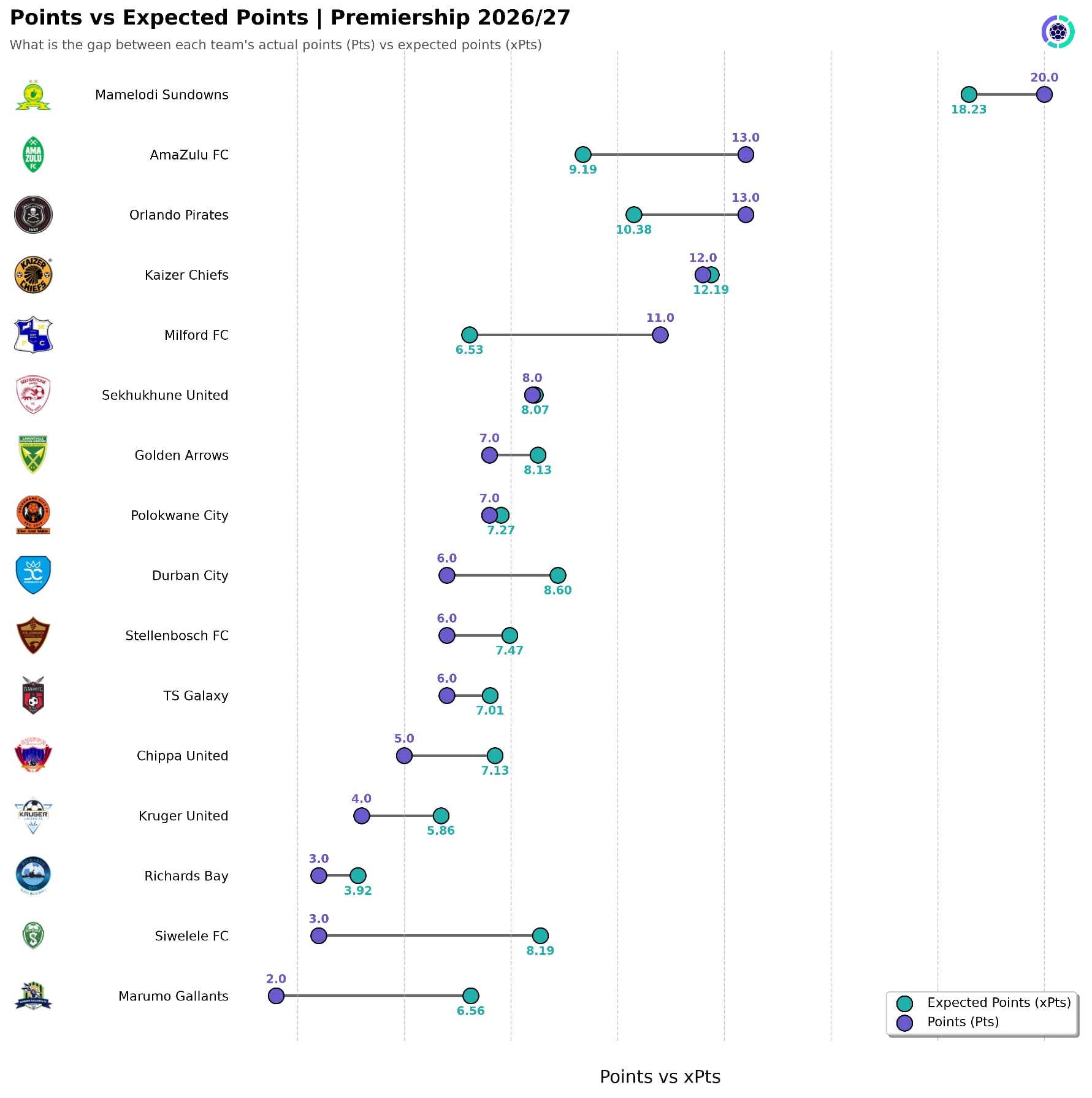
At the other end of the table, the likes of Marumo Gallants and Siwelele are the biggest under performers, and are stuck in the relegation zone. Siwelele will point to a difficult fixture list to open the season, and they may be justified. Like Marumo, they’ll both be leaning on experience to take them further up the table, but that starts with taking the chances they’re creating. The dust will settle a bit after the international break, albeit with a coaching merry-go-round seemingly afoot at most clubs, leaving only a handful of teams as outliers.
We’ll come back to this in Q2 to see if there really is a class breakaway in the division.
This newsletter was sponsored by Easybet, whose support made this edition possible. Use code LAD50 at Easybet: http://bit.ly/LAD50